
By Daily Sports Nigeria on August 21, 2026
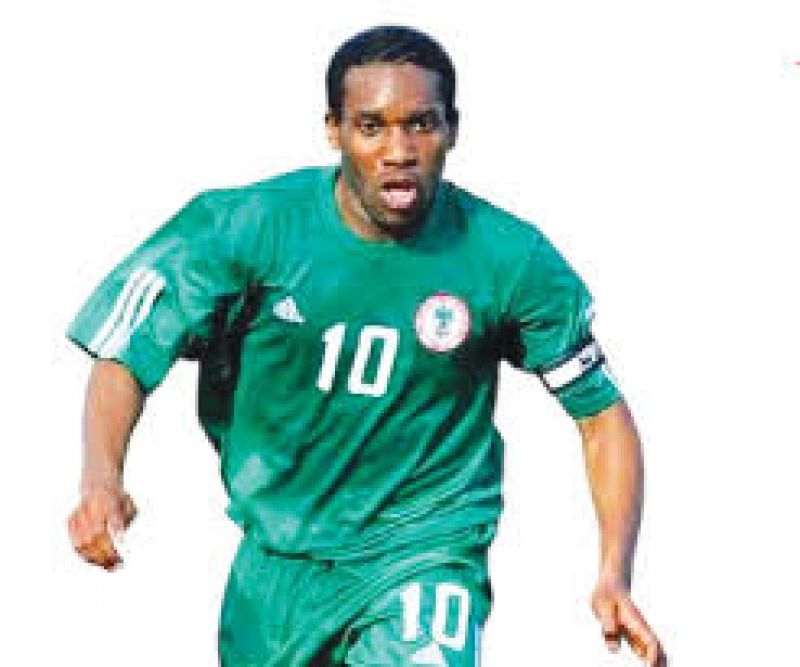
Super Eagles legend Austin “Jay-Jay” Okocha speaks on his rise through Germany, Turkey and France to the Premier League, the managers who shaped him, the discrimination he faced as an African player and more in this interview on the ObiOne podcast culled by PETER AKINBO
In your early days, did you play in the Nigerian league?
Not really. I only played a little, because I had just finished secondary school. During my final year, I was playing for an amateur team, and we came up against Rangers in a cup competition. My elder brother was playing for them at the time, so after the game, they invited me for trials. I went through the trials and they signed me, but I never really got the opportunity to play for them because I got a chance to travel and moved abroad.
Who was the biggest influence on the way you played?
Nobody, really. It all started as fun on the street, where we developed our love for football. It was not organised, so we had the freedom to try whatever we wanted. I realised I could do a lot with the ball, and because it was never pre-planned, I always had to decide in the moment. That became my strength, because I knew that once I had the ball, I was the only one who knew what I wanted to do with it. That was how I built the confidence to try things in matches.
Did you have a manager who screamed at you because of your style?
Oh yes, a couple of them. I had Jupp Heynckes at Frankfurt, I had Luis Fernandez at Paris Saint-Germain, and even Sam Allardyce at Bolton. In our own half, where most people would just clear the ball, I preferred to control it and build from the back, and that used to give some of them a heart attack. But it was also about me being willing to learn what was needed of me, because you cannot spend 90 minutes flicking the ball over people, even though that is sometimes all people show.
Was entertaining the crowd as important to you as winning?
No, it was always about winning. Do not forget it is business, and you live off it. The way I played may have made it look as if I was not playing to win, but I hated losing. I could not sleep if we lost. I just had to play to my strength, because that was the value I could add to the team.
Can you talk us through that famous goal against Karlsruher SC and Oliver Kahn while you were at Frankfurt?
That goal changed my life. It was shown across Europe and gave me recognition outside Germany. Kahn was having his best season then, which was why Bayern signed him afterwards. Whenever I wanted to shoot, I kept seeing another defender in front of me, so I was just looking for the right moment, and it took longer than I wanted.
How was your overall time at Eintracht Frankfurt?
I had a great time, and I think it was in Frankfurt that I became a man, because that was where I faced my biggest challenges in football. Part of your contract in Germany then was tied to appearances, so only about 30 per cent was guaranteed, and the rest depended on how many matches you played. You can imagine the competition that created in training. I came in as a young boy from the third division, and some of the senior professionals ganged up on me, but I was there to stay, and that taught me that talent alone is never enough. You have to match your opponent’s hard work and add your natural ability on top of it.
You then moved to Fenerbahçe in Turkey. How was that experience?
I went there as a big transfer, straight from winning Olympic gold with Nigeria in Atlanta. I actually flew from the United States to Israel for a Champions League qualifier almost immediately afterwards. The pressure in Turkey is huge, but you must love football to play there, because the fans are priceless when things are going well. When it is not going well, though, it is hell. I enjoyed my two years there so much that the club did not want to let me go.
Can you tell us about your relationship with Ronaldinho at PSG?
It was more like I had finally found someone I could truly play with. The understanding between us was something else, because he grew up learning the game on the street the same way I did. I sacrificed a little for him, sitting back a bit more to give him room to do what he did best.
You have spoken before about facing discrimination as an African player in Europe. Can you expand on that?
I would not necessarily call it racism, but I believe there was clear discrimination, and as an African player, you had to be ten times better than a European to stand any chance. In Germany then, each club could only field three non-German players, no matter where they were from, so imagine how slim the chances were for a young African to break through. There was no social media then, so we had no real voice, and we simply had to accept it because our focus had to remain on our goal, and our families were depending on us.
Moving to Bolton and the Premier League, how did you adapt to the physicality?
I knew I was coming into a tougher league, and I saw it as a challenge, because the question everywhere was whether my style could survive there. English players tend to make a decision and stick to it, so you have to be quick in your thinking. I could not learn how to tackle overnight, so the only way I could cope was by staying true to my identity and bringing something different to a club that was seen as a struggling side.
Looking back, given that Bolton were later relegated to League One, do you have any regrets about the four years you gave the club?
I would not call it regret. If you make a decision, you live with it. Some players get the chance to win titles, others get the chance to change lives, and people do not always realise how deep football runs. During our first difficult season, fans would stop me while I was doing my grocery shopping and ask if I was going to keep the club up. That is what success meant to them, because Bolton had never survived two seasons in a row in the top flight before I signed. Ultimately, the people running the club were simply not as ambitious as those of us on the pitch.
Can you tell us about Nigeria’s 1994 Africa Cup of Nations win and the 1996 Olympic gold in Atlanta?
In 1994, we had maybe one of the best Nigerian teams ever, but we did not fully realise how good we were until afterwards. By 1996, half of that squad had gone on to compete at the Olympics, and we now had the belief that we could go all the way. We had already lost to Brazil in the group stage, so going into the semi-final we felt lightning could not strike twice. It took us until the last minute to get the equaliser, but everything worked out, even though I had missed a penalty earlier that could have given us more time. That Brazilian team also had outstanding players, so credit must go to them too. Also, our government had issues with South Africa at the time and stopped us from going to the 1996 Nations Cup, and then CAF banned us from the 1998 edition. We lost so many of those players afterwards, and with the squad we had, I genuinely believe we could have won at least one more Nations Cup in that period, because we had more players in Europe, and in decent clubs, than most other African countries at the time.
Would you be interested in taking up a role in Nigerian football administration?
It would be unfair to football lovers for someone like me to say I am not interested, but the mess is sometimes so bad that you ask yourself if it is even worth trying. I did try a little, with Delta State, but when I saw how things were run, I stepped back. Still, I believe history will not forgive us if we keep quiet, even though speaking out creates enemies. We do not have a permanent camping site as a nation, and we have gone two qualifying cycles now without reaching the World Cup. Those in charge have to go, and I have said so many times. It is not rocket science; we simply need the right structure and the right people adding value.
In your opinion, who is the greatest African footballer you have seen?
I will give it to George Weah. He is the only African to win the Ballon d’Or, and the numbers back that up. I saw Samuel Eto’o and Didier Drogba play too; great players both, but for me, it is Weah.
Which opponents troubled you the most?
Honestly, I never really thought about it that way, because my focus was always on my own strengths when I had the ball. But there were players you had to be careful around, like Rigobert Song and Taribo West, who tackled to hurt rather than just to win the ball, so that you would think twice about coming back for more.
Finally, Lionel Messi or Cristiano Ronaldo?
Messi. Ronaldo is a special player, and I respect his level of consistency and the hard work behind what he has achieved, because in my opinion, he is not the most naturally gifted. But Messi was born to play football. Sometimes he looks like he is just walking around, but once the ball reaches him, you realise he has been scanning the whole time. That is a gift.
oking ba
Source Punch Ng
Posted August 21, 2026
You may also like...
Pele: Ronaldo The Best Player In The World...
FIFA President faces suspension just 3 months after...
Spurs Offer To Sevilla’s Lopetegui Turned Down
Dortmund cruise past Hanover to go nine points...
Anthony Joshua open to fight with MMA opponent...
Manchester United Held By Aston Villa
 Olayinka ready for Saudi journey
 Why NSC picked Lagos to host intermediate games – DG
 EFCC, ICPC summon NFF officials over N12bn FG fund
 Missing ’96 AFCON, CAF ban cost Eagles trophies – Okocha
 D’Tigress intensify World Cup prep in Spain
 Onuachu, Ndidi, Yohanna lead 12 Nigerians into Europa, Conference League playoffs
 Lagos revives monthly cadet table tennis tourney
 Fizdale names D’Tigers roster for World Cup qualifiers
 Hearn threatens to sue White over Joshua, Fury fight
 UK ex-Commonwealth champion Baptiste found jailed in Morocco
 Why elite athletes use supplements — Report
_7.jpg) No Kangaroo Committee Can Save Gusau, his NFF Jesters - Give Us Emenalo
No Kangaroo Committee Can Save Gusau, his NFF Jesters - Give Us Emenalo
Most Read
 Rangers International going, going . . . (64,039 views)
 Amaju Pinnick: A cat with nine lives (55,397 views)
 Second Term: Amaju Pinnick, Other NFF Heavyweights Home to Roost •How Pinnick Broke the Jinx (53,286 views)
 Current issues in Nigerian sports: Matters arising (52,890 views)
 Sports Development: Zenith Bank on the zenith (52,767 views)
 Missing $150,000 IAAF Grant: Solomon Dalung’s Hide and Seek game (52,642 views)
 Gov. Abdullahi Ganduje’s solid footprints, commitment to sports development in Kano State (52,538 views)
 NFF Presidency: Pinnick, Maigari, Ogunjobi, Okoye in Battle for Supremacy (52,052 views)
 Olopade, BET9A wave of revolution in NNL (51,255 views)
 Commonwealth Games 2018: Shame of Muhammadu Buhari, Solomon Dalung (49,727 views)
 Ibrahimovic’s Man U exit: Whose decision is it? And in whose interest? (48,213 views)
 John Mikel Obi: Segun Odegbami’s Outrageous Call! (47,594 views)